Career Services vs. Academic Advising: Roles, Referrals & Handoffs
Learn how career services and academic advising can work together without duplicating support. This guide covers where responsibilities should overlap, where they should stay separate, how to build clearer referrals and handoffs, and how colleges are coordinating the two functions in practice.


How should career services and academic advising work together?
Career services and academic advising should work together by defining where their roles overlap, which responsibilities stay with specialist staff, and how students move between the two teams without repeating the same conversation. Academic advising should own curriculum, degree progress, registration, prerequisites, and academic policy, while career services should own career exploration, resumes, interviews, job search, employer-facing activity, and offer support. The overlap appears when students need to connect majors, courses, internships, skills, and career goals. A strong model uses shared language, referral triggers, clean handoffs, FERPA-aligned notes, and focused cross-training so each team supports students without duplicating work or blurring expertise.
If you lead a career center, some overlap with academic advising is unavoidable.
Students do not separate questions about majors, courses, internships, skills, and careers as neatly as university org charts do.
Treating the two functions as completely separate can leave students moving between offices and repeating the same context. But asking academic advisors and career coaches to provide the same support creates a different problem: duplicated work, blurred expertise, and uncertainty about who actually owns the next step.
The focus should be on defining where the two teams overlap, which responsibilities stay with specialist staff, and how students move between academic and career support without unnecessary duplication.
This guide provides a practical model for doing that, with examples other institutions already connecting academic advising and career development.
What is the Difference Between Academic Advising and Career Services?
Academic advising primarily helps students make informed academic decisions and progress through their program, while career services focuses more deeply on career exploration, professional preparation, experiential learning, job search, and employer-facing activity. The overlap appears when students need to connect an academic choice with what they want to do beyond college.
The distinction matters because students increasingly expect career conversations to happen outside the career center.
According to Inside Higher Ed and College Pulse Student Voice survey, 65% of students said their ideal level of academic advisor involvement in career preparation was a four or five on a five-point scale.
Students are already taking career questions elsewhere. The better question is what those campus partners should handle themselves and what should move to a career specialist.
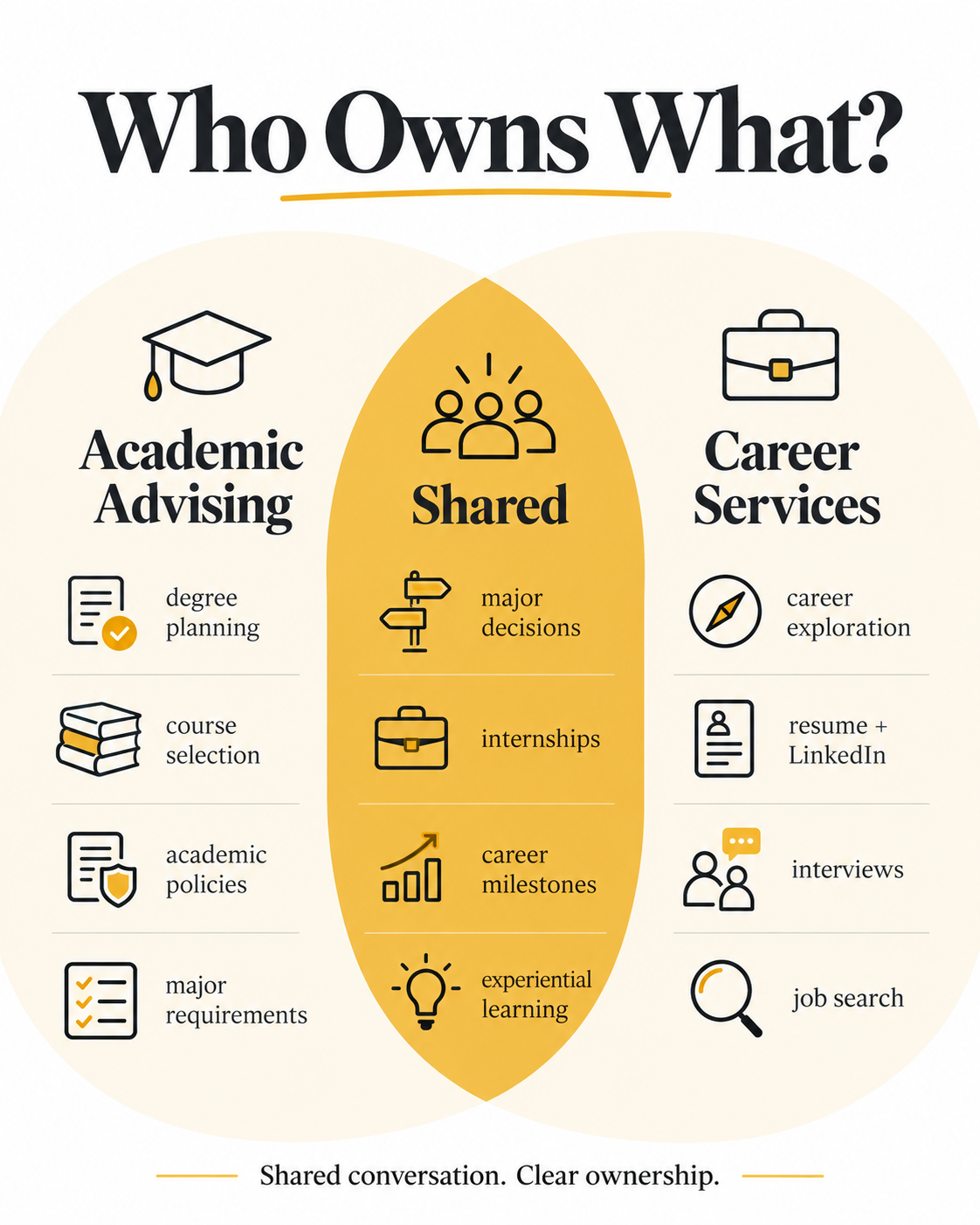
A useful starting division looks like this:
| Student need | Primary owner | Where the other team contributes |
|---|---|---|
| Degree requirements and graduation progress | Academic advising | Career services can connect the academic plan to career goals |
| Course sequencing and registration | Academic advising | Career services can identify skills or experiences students may want to build |
| Academic policies, standing, or program rules | Academic advising | Career services should refer rather than interpret policy |
| Choosing or changing a major | Shared | Academic advising explains requirements and pathways; career services helps explore interests, occupations, and implications |
| Career exploration | Career services | Academic advisors can introduce the conversation and identify when deeper exploration is needed |
| Resume, cover letter, LinkedIn, and interview preparation | Career services | Academic advisors should recognize the need and route students to the right resource |
| Internship or job search | Career services | Academic advisors can help students plan the experience around academic commitments |
| Internship-for-credit requirements | Shared | Career services supports search/preparation; the academic unit determines credit and curricular requirements |
| Experiential learning | Shared | Academic advising connects experiences to degree planning; career services connects them to career development |
| Employer recruiting and career fairs | Career services | Academic advisors can promote opportunities to relevant students |
| Job offers and negotiation | Career services | Academic advisors generally refer rather than duplicate specialist coaching |
This is not a universal staffing chart. Institutions organize these functions differently.
The more useful principle is: share the developmental conversation, but keep specialist decisions with the team that owns the expertise.
Where Should Career Services and Academic Advising Naturally Overlap?
The strongest overlap is where an academic decision has career implications: choosing a major, identifying useful experiences, connecting coursework to skills, considering internships, and deciding what a student should do next. Both teams can reinforce these connections without providing identical services.
Indiana University provides one of the clearest current examples.
Its 2024 Framework for Academic Advising & Career Development calls collaboration between advising and career services integral to embedding academic and career planning across the student experience.
IU specifically recommends cross-training, shared technologies, regular joint meetings, common communication channels, career milestones inside academic planning, and data on jointly valued metrics.
The framework also establishes several joint expectations rather than assigning every career task to one office. Both groups are expected to help students reflect on values, interests, strengths, academic goals, professional goals, work-based learning, and the connection between degree maps and career milestones.
That creates a useful model for other institutions.
| Shared conversation | Academic advising contribution | Career services contribution |
|---|---|---|
| "I'm not sure this major is right for me." | Explain alternatives, requirements, time-to-degree implications | Explore interests, career possibilities, work environments, and occupational information |
| "What can I do with this major?" | Connect curriculum and academic opportunities | Connect the major to occupations, industries, alumni paths, skills, and labor-market information |
| "Which experiences should I pursue?" | Identify academically relevant research, electives, minors, and credit-bearing options | Identify internships, micro-internships, projects, job shadowing, networking, and employer opportunities |
| "What skills am I actually building?" | Help identify learning from coursework | Help translate that learning into employer-facing language and career-readiness competencies |
| "Should I take this internship?" | Discuss academic timing, credit, prerequisites, and degree implications | Evaluate career relevance, responsibilities, learning value, and professional opportunity |
| "What should I be doing this year?" | Place career milestones within the academic plan | Define the career actions appropriate for that stage |
The overlap should help students connect information, not make them choose which office's version of the answer to trust.
Which Responsibilities Should Stay Separate?
Collaboration should not turn academic advisors into substitute career coaches or career staff into substitute academic advisors. Degree audits, registration policies, course requirements, specialized job-search coaching, employer recruiting, resume strategy, interviewing, and negotiation all benefit from clearly identified ownership.
This is where many integration efforts can go wrong.
Cross-training is useful when it helps a staff member recognize a need. It becomes inefficient when two teams are trained to deliver the same specialist service independently.
Washington State University provides a useful example of maintaining distinction inside a connected model. Its Academic Success & Career Center tells students that academic advisors help with classes, pass/fail options, changing majors, and other academic choices, while career coaches provide assessments, career exploration, resumes, job and internship search, networking, interviewing, and career planning.
Similarly, the University of Utah's Academic Advising & Career Success Regional Model explicitly states that academic advisors continue to guide students on course planning and degree requirements, while career coaches connect those choices to professional pathways.
That distinction should remain visible even when the teams report through the same leadership structure.
A simple test is:
| Question | Best response |
|---|---|
| Does this require authoritative knowledge of curriculum, degree policy, or registration? | Academic advising owns it |
| Does this require employer, recruiting, job-search, or career-development expertise? | Career services owns it |
| Does it require both academic and career context to make a good decision? | Coordinate the response |
| Can the first team answer the question accurately in a few minutes without replacing specialist support? | Answer it, then refer deeper work if needed |
| Would two appointments result in essentially the same conversation? | Redesign the referral or clarify ownership |
The idea is to ensure the student gets the deepest expertise without paying for it through unnecessary appointments.
How Should Career Services and Academic Advising Build a Clear Referral System?
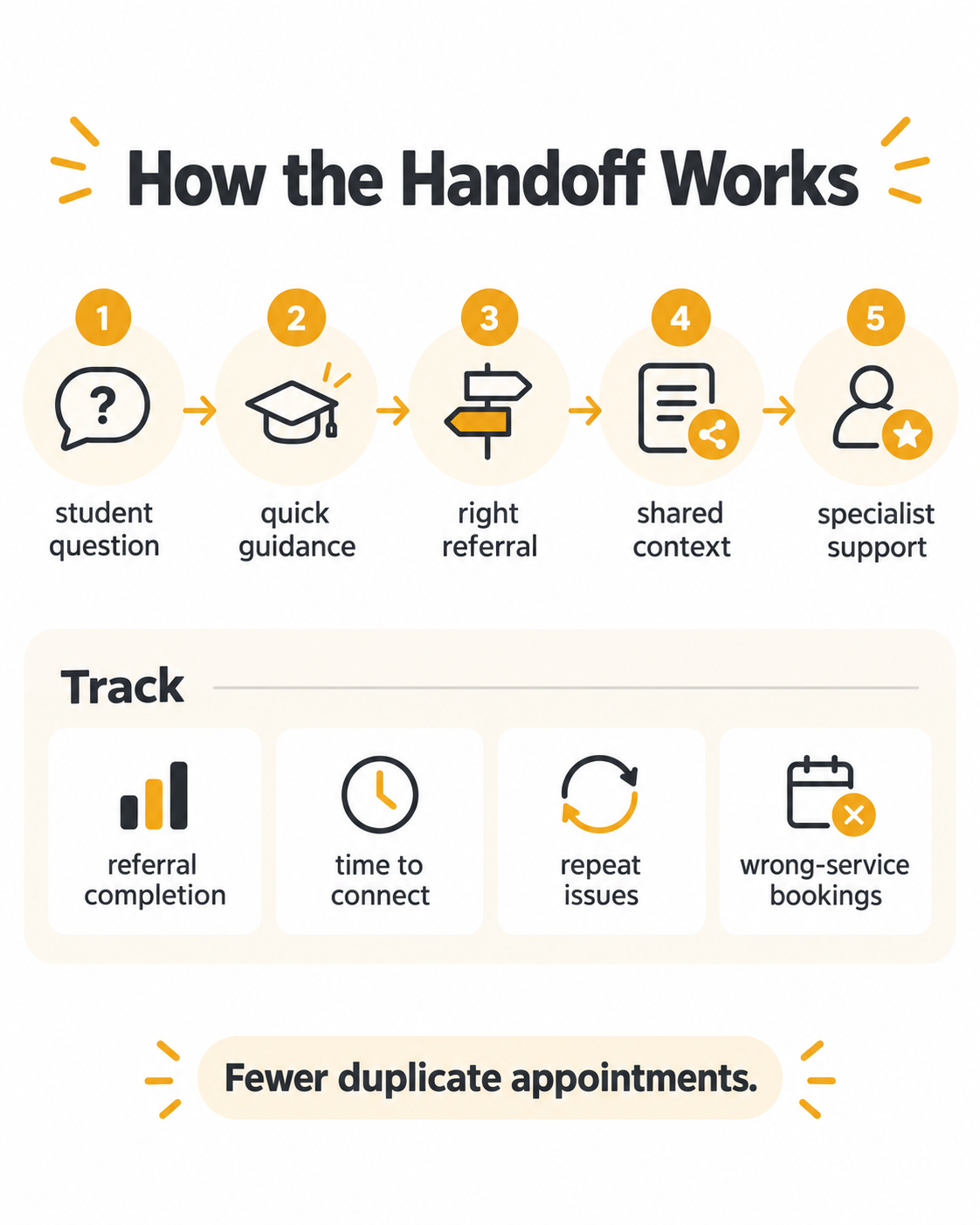
Start with specific referral triggers rather than telling staff to "refer students to career services when appropriate." Define the student questions that should trigger a referral, the exact service they need, what context should follow them, and whether the first office needs to know what happened next.
Indiana University's framework makes this explicit. One expectation for career services professionals is to train academic advisors on when and how to refer students to career services.
"Go visit the career center" is therefore not a referral system.
A more useful referral map looks like this:
| What the student says | What the advisor can do now | Referral |
|---|---|---|
| "I have no idea what I want to do." | Explore immediate academic concerns and whether uncertainty is affecting registration | Career exploration appointment or assessment |
| "I'm choosing between these two majors because of job prospects." | Explain program requirements, sequencing, and switching implications | Career exploration or labor-market conversation |
| "Can you check my resume?" | Explain where specialized review is available | Resume review tool, drop-in, or coaching appointment |
| "I need an internship next semester." | Check how an internship fits the academic plan | Internship search/preparation support |
| "Does this internship count for credit?" | Review or route to departmental credit requirements | Career services only if search or professional preparation is also needed |
| "I have an interview Friday." | Avoid creating another general career referral | Route directly to interview practice/resources |
| "I received an offer but don't know whether to accept." | Discuss academic implications if relevant | Offer evaluation/negotiation support |
| "I want graduate school but don't know which path makes sense." | Explain academic prerequisites and program requirements | Career or specialized pre-professional advising for decision support and application strategy |
The referral should also tell the student why they are being referred.
Compare:
"You should talk to Career Services."
with:
"Your academic plan works for either major. The next question is which path fits the work you want to pursue, so I'm referring you to career exploration. They can help you compare the occupations, work environments, and experiences associated with both options."
The second handoff tells the student what has already been resolved and what the next team is expected to help resolve.
What Should a Good Student Handoff Look Like?
A good handoff carries the student's progress forward. The receiving team should know what has already been discussed, the student should know why they are moving to another service, and both offices should avoid restarting the conversation unless new context genuinely requires it.
This becomes especially important at predictable transition points.
Washington State's integrated model provides one example. Career coaches in its Academic Success & Career Center can also advise undecided students, and when a student declares a major, the student transitions to advising within the relevant college or department.
WSU also provides academic advisors across campus with career-readiness resources and training so the career conversation does not disappear after that transition.
Career centers can define similar handoffs around other milestones:
| Transition | Information that should carry forward | Next owner |
|---|---|---|
| Undecided → declared major | Interests considered, academic decision, remaining career questions | Major advisor + career services as needed |
| Major change | New academic plan, reason for change, unresolved career assumptions | Academic advisor with targeted career referral |
| Pre-internship | Timing, eligibility, academic constraints, career target | Career services |
| Internship secured | Employer, role, dates, credit status, learning goals | Academic unit + career/experiential learning team |
| Junior → active job search | Graduation timeline, target industries/roles, prior career engagement | Career services |
| Graduate-school decision | Prerequisites completed, program interests, decision factors | Academic/pre-professional + career support as appropriate |
The handoff should eliminate repetition, not eliminate contact between the teams.
How Should Academic Advising and Career Services Share Student Notes?
Share enough context to support continuity, but do not assume every employee should see every note. Institutions should establish approved systems, note-writing standards, access rules, and FERPA-aligned permissions based on staff responsibilities and legitimate educational interest.
UW-Madison provides a useful operational example.
Its institution-wide Advising Gateway and Notes system allows authorized staff to review student interaction history and document outcomes.
Academic advising, career advising, student services, and student affairs are among the roles that may qualify for access when their work requires it.
UW-Madison also requires staff seeking Notes access to complete a dedicated training course and pass a final quiz with a score of at least 90%.
Indiana University similarly expects both academic advising and career professionals to schedule and document interactions in the university's official enterprise tool and calls for joint solutions for notes and appointment systems.
But shared technology does not mean unrestricted visibility.
The U.S. Department of Education states that FERPA permits disclosure without consent to school officials whom the institution has determined have a legitimate educational interest in the information.
It also says institutions must use reasonable methods to make sure officials access only records for which that legitimate educational interest exists.
Career and advising leaders should therefore work with their registrar, privacy, legal, or institutional data teams on access rules rather than creating an informal shared spreadsheet.
For the collaboration itself, a useful note normally needs to answer three things:
What did the student come in for? What was resolved? What still needs to happen?
That is usually more useful to the next professional than a transcript of the entire conversation.
How Much Career Training Should Academic Advisors Receive?
Train academic advisors to recognize career-development needs, have basic career conversations, use shared resources, and make precise referrals. Do not expect every academic advisor to become equally skilled in resumes, interviewing, labor-market analysis, employer recruiting, negotiation, and specialized job-search strategy.
Cross-training works best as routing competence plus shared language.
Indiana University expects cross-training between academic advising and career services while still maintaining separate expectations for each professional group.
Career services professionals, for example, retain deeper responsibilities for career exploration, job search, networking, negotiation, labor-market trends, and career education at scale.
Washington State follows a similar model through its Advisor Learning Program and career-readiness resources for academic advisors.
The university gives advisors access to resources on NACE competencies, career exploration, labor-market information, internships, LinkedIn, Handshake, career assessments, networking, and other tools while keeping specialist career-coaching services available.
A practical training boundary looks like this:
| Every academic advisor should be able to | Career specialists should retain deeper expertise in |
|---|---|
| Ask about career goals when relevant | Career assessments and interpretation |
| Connect course choices to broader goals | Advanced career exploration |
| Introduce career-readiness competencies | Resume and cover-letter strategy |
| Identify experiential-learning opportunities | Interview coaching |
| Recognize when career uncertainty is affecting academic decisions | Job and internship search strategy |
| Explain what career services offers | Networking strategy |
| Make a specific referral | Employer and recruiting knowledge |
| Reinforce career milestones | Offer evaluation and salary negotiation |
The reverse also applies.
Wrapping Up
Career staff should understand enough about degree structures and academic processes to avoid sending students to the wrong place, but they should not independently interpret academic policies they do not own.
Career services and academic advising work best when students can move between them without having to restart the same conversation. Clear ownership, precise referrals, shared context, and well-defined handoffs allow each team to stay focused on its expertise while giving students more continuous support.
Hiration can support the career-services side of that model through a full-stack career readiness suite spanning Career Assessments, AI-powered Resume Optimization, Interview Simulation, LinkedIn Optimization, and more.
A separate Counselor Module helps career teams manage cohorts, workflows, student activity, and analytics within a FERPA- and SOC 2-compliant platform.
If your team is looking to make career support easier to coordinate across more student touchpoints, book a walkthrough to see Hiration can fit into your existing advising and career-services structure.
Academic Advising and Career Services — FAQs
What is the difference between academic advising and career services?
Academic advising primarily helps students make informed academic decisions and progress through their program. Career services focuses more deeply on career exploration, professional preparation, experiential learning, job search, employer engagement, interviews, resumes, networking, and offer support.
Where do academic advising and career services overlap?
The overlap appears when an academic decision has career implications. This includes choosing a major, identifying useful experiences, connecting coursework to skills, considering internships, planning yearly milestones, and helping students understand how academic choices connect to life after college.
Why should career centers coordinate with academic advising?
Career centers should coordinate with academic advising because students often bring career questions to academic advisors before visiting the career center. Coordination helps students receive consistent guidance, avoid repeated appointments, and move from academic planning to career preparation without losing context.
Which responsibilities should stay with academic advising?
Academic advising should retain ownership of degree audits, registration policies, course requirements, prerequisites, academic sequencing, major changes, credit implications, and time-to-degree questions. Career staff should not independently interpret academic policies they do not own.
Which responsibilities should stay with career services?
Career services should retain deeper responsibility for career exploration, resumes, cover letters, LinkedIn, job and internship search, employer recruiting, networking, interview coaching, offer evaluation, negotiation support, labor-market interpretation, and specialized career-development guidance.
How can teams decide who should answer a student question?
Teams can ask whether the question requires curriculum or registration expertise, employer or career-development expertise, or both academic and career context. If the first team can answer accurately in a few minutes, it can answer and refer deeper support when needed.
What should academic advisors do when students ask career questions?
Academic advisors can ask basic career-goal questions, connect course choices to broader goals, introduce career-readiness competencies, recognize when career uncertainty affects academic decisions, explain what career services offers, and make a specific referral to the right career resource.
What should not be pushed onto academic advisors?
Academic advisors should not be expected to become full career coaches. Specialized resume strategy, interview coaching, job-search planning, employer recruiting knowledge, negotiation, advanced career exploration, and labor-market analysis should remain with career specialists.
How should career services and academic advising build a referral system?
The referral system should define specific student questions, the service each question should trigger, the context that should carry forward, and whether the first office needs to know what happened next. “Go visit the career center” is not specific enough to function as a useful referral.
What makes a referral from academic advising to career services useful?
A useful referral explains why the student is being referred, what has already been resolved, and what the career team should help with next. For example, an advisor may clarify that the academic plan works for either major, but the student now needs help comparing career paths.
What should a good student handoff include?
A good handoff should carry the student’s progress forward. The receiving team should know what the student came in for, what has already been discussed, what was resolved, what still needs to happen, and why the student is being moved to another service.
When do students need handoffs between advising and career services?
Handoffs are especially useful when students move from being undecided to declaring a major, changing majors, preparing for internships, securing internships, beginning an active job search, or deciding between graduate school and employment options.
How should academic advising and career services share student notes?
Teams should share enough context to support continuity without assuming every employee should see every note. Institutions should establish approved systems, note-writing standards, access rules, and FERPA-aligned permissions based on role, responsibility, and legitimate educational interest.
What should a shared advising note include?
A useful shared note usually answers three questions: what the student came in for, what was resolved, and what still needs to happen. This is more useful for the next professional than a full transcript of the conversation.
Why should teams avoid informal shared spreadsheets for student notes?
Informal shared spreadsheets can create access, privacy, and governance problems. Career and advising leaders should work with the registrar, privacy, legal, or institutional data teams to define approved systems and access rules before sharing student interaction notes.
How much career training should academic advisors receive?
Academic advisors should receive enough training to recognize career-development needs, have basic career conversations, use shared resources, and make precise referrals. Cross-training should create routing competence and shared language, not turn every academic advisor into a full career specialist.
What career topics should academic advisors understand at a basic level?
Academic advisors should understand how to ask about career goals, connect course choices to broader goals, introduce career-readiness competencies, identify experiential-learning opportunities, recognize career uncertainty, explain career services, make referrals, and reinforce appropriate career milestones.
What should career staff understand about academic advising?
Career staff should understand enough about degree structures, academic processes, registration constraints, prerequisites, and academic referral routes to avoid sending students to the wrong place. They should not independently interpret academic policies that belong to academic advising or departments.
How can career centers reduce duplicated work with academic advising?
Career centers can reduce duplication by clarifying ownership, using specific referral triggers, sharing concise context, building defined handoffs, training advisors on routing, and making sure students do not have to repeat the same background information across multiple offices.
How can Hiration support coordination between academic advising and career services?
Hiration can support the career-services side of the model through Career Assessments, AI-powered Resume Optimization, Interview Simulation, LinkedIn Optimization, and other career-readiness tools. Its Counselor Module helps career teams manage cohorts, workflows, student activity, progress, and analytics within a FERPA and SOC 2-compliant platform.